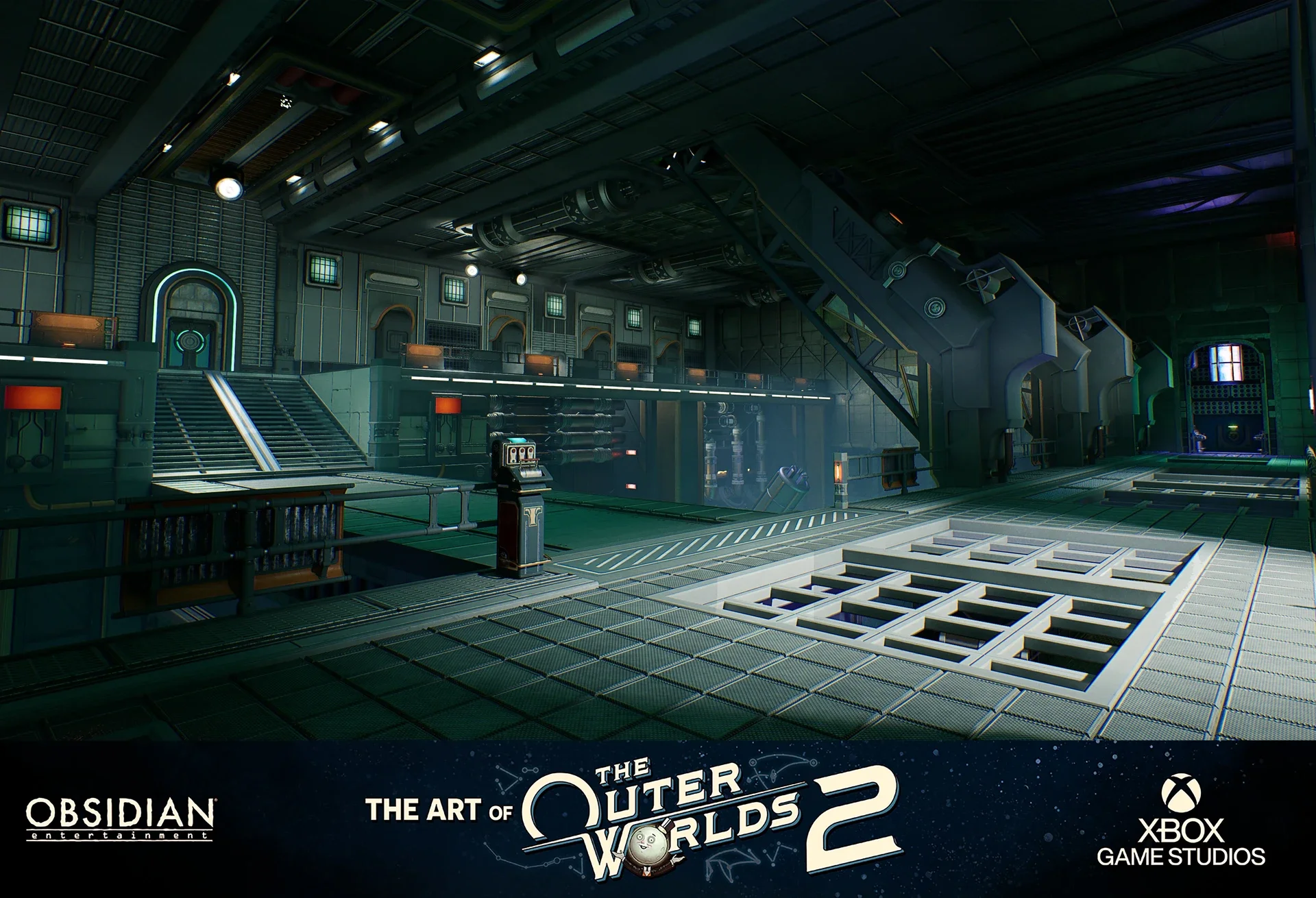
Overview
Greater Tranquility Station is a derelict space station owned by the Order of the Ascendant (faction) that is currently being used as a venue to host peace negotiations between The Order of the Ascendant and Auntie’s Choice. When the player arrives, they are hot on the trail of the traitor Augustine De Vries who they’ve been hunting since the game began. We’re now roughly 10-15 hours into the main quest and at the climax of Act 1. The player must make their way through the derelict station, now flooded with the minions of De Vries and reach her before she brings a violent end to the negotiations.
I was assigned as the supporting designer on this Large Dungeon, with the specific responsibility of creating the spaces and experience leading from level start through to the boss fight just before reaching De Vries. I handled conceptualization for these spaces and their gameplay, documentation, level architecture, encounter design, unique gameplay objects and scripting throughout the experience.
Greater Tranquility Station
The control room for the Greater Tranquility Station Hangar the player lands in. Provides terminal control to DeVries’s (Antagonist) ship for optional exploration.
Consideration: Establish Story
When the player first enters the Hangar Control Room, they encounter opposition. If they killed Proctor Svoboda at the Zyranium Manufactory, they will face the more timid and less seasoned Factor Invino. If they left Proctor Svoboda alive, she will face off against the player with dialogue options to call back to your previous meeting and debuff her.
When the player lands in Greater Tranquility Station, all they know is that they are here to stop De Vries from interrupting the peace talks. The first thing I needed to do was deliver on player expectations and establish the story here. After all, not everyone reads the dialogue (I know I’m guilty).
After exiting their ship, the player is positioned facing the stairs down to the entrance to the station and exit from the hangar. To their immediate right is De Vries ship occupying the second landing pad. Behind her ship is a massive window showing the backdrop of space, in case you forgot this was a space station :P. As you exit the hangar, I triggered the screens above the entrance and within to turn on, showing the two delegates in a large forum with a similar looking large window behind them involved in a debate. They are dressed in a manner that clearly represents the two factions at play here as they kick off the peace negotiations.
Once entering, to the player’s right is a window next to the control tower entrance door that puts one of the traitorous leaders and their henchmen in clear line of sight. The player may optionally go out onto a large bridge blocked by an electric fence, providing glimpses of the spaces within the station they will soon venture to.
Upon speaking with the leader of the traitors the player receives some reactive dialogue based on their choices in the previous region, and is informed that De Vries made her way to the forum to put an end to the negotiations and that their team is positioned throughout the station to guarantee it the likes of the player does not disrupt it. The player now knows all the important story points as context for the gameplay ahead and their motivation for engaging with it within their first five minutes in the Dungeon.
Consideration: Manufactured Urgency
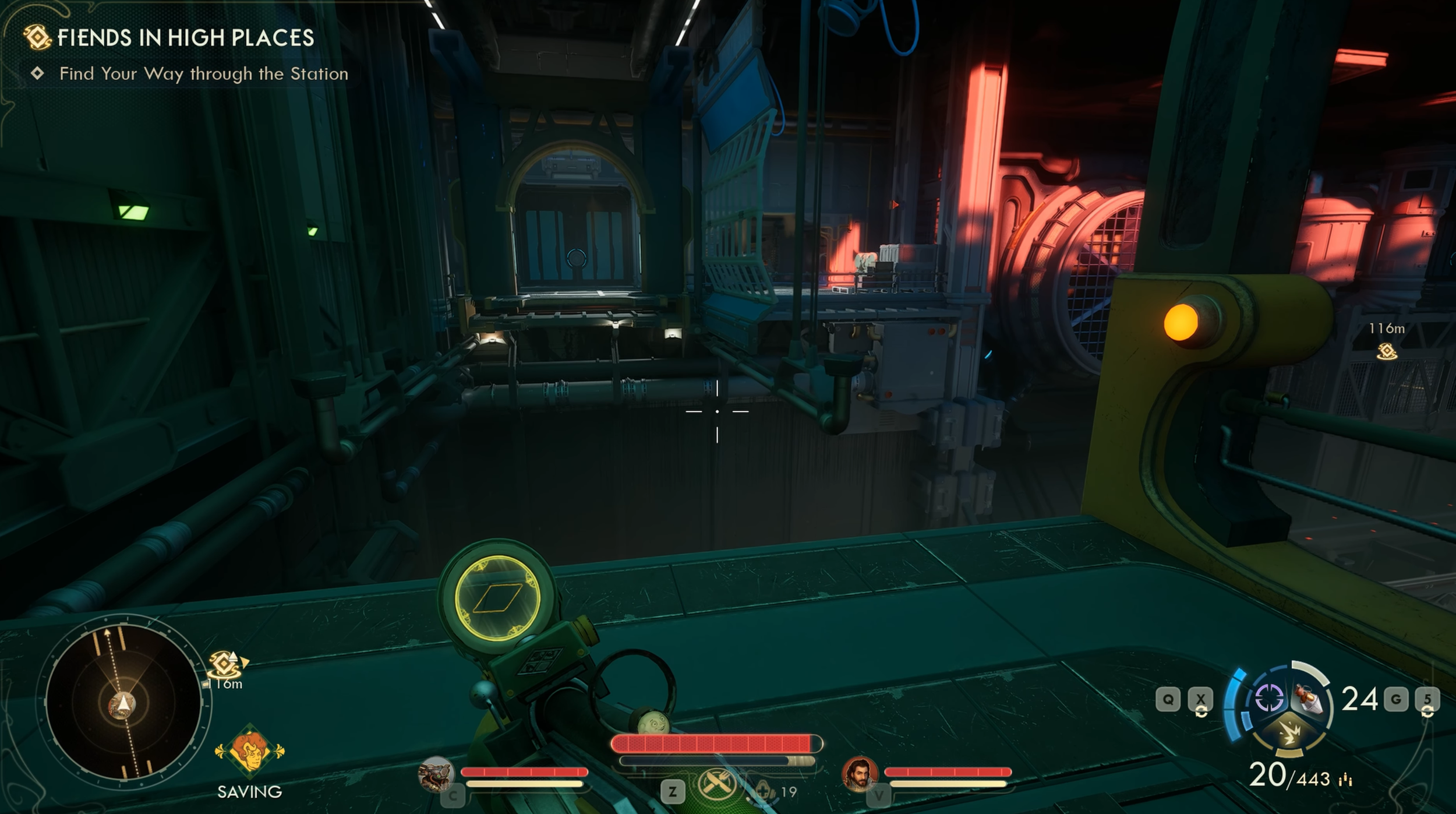
The player takes the first horizontal lift across the machine corridor to the Turbine Chamber.
Quite possibly the hardest challenge I had to tackle across development of The Outer Worlds 2 was the matter of manufacturing a sense of urgency for players when a design constraint is to never have time limitations on content. By virtue of it being a game that emphasizes allowing players to play in the manner they would like, it was decided early on that anything involving Time of Day or time constraints could seem tedious and could create undesirable friction.
However, a problem arose as we progressed through development. How do we create tension and urgency in these big story moments? When the player is hot on the trail of a traitor and told they need to stop them quickly or else, but we have no true consequence to enact, how do we make the player feel there are stakes? Truth be told, I don’t believe we ever found a fantastic solution to this that substitutes that truly punishing feeling of “You Failed” appearing on the screen and restarting me at my last checkpoint like failing a chase mission in a 007 game.
In lieu of a truly consequential mechanism, I decided to tap the talents of my assigned narrative designer, Kelsie Mhoon. I created multiple conditional triggers throughout the different chambers the player would traverse that would fire off reminders to the player from their companions that time is of the essence and they don’t have time to idle. The direction provided to the Voice Actors then amped up the sense of urgency in their tone of voice.
While this approach was antithetical to our game pillar of promoting exploration, it was essential for achieving the central story goal for the level.
Consideration: Encounter Permutations
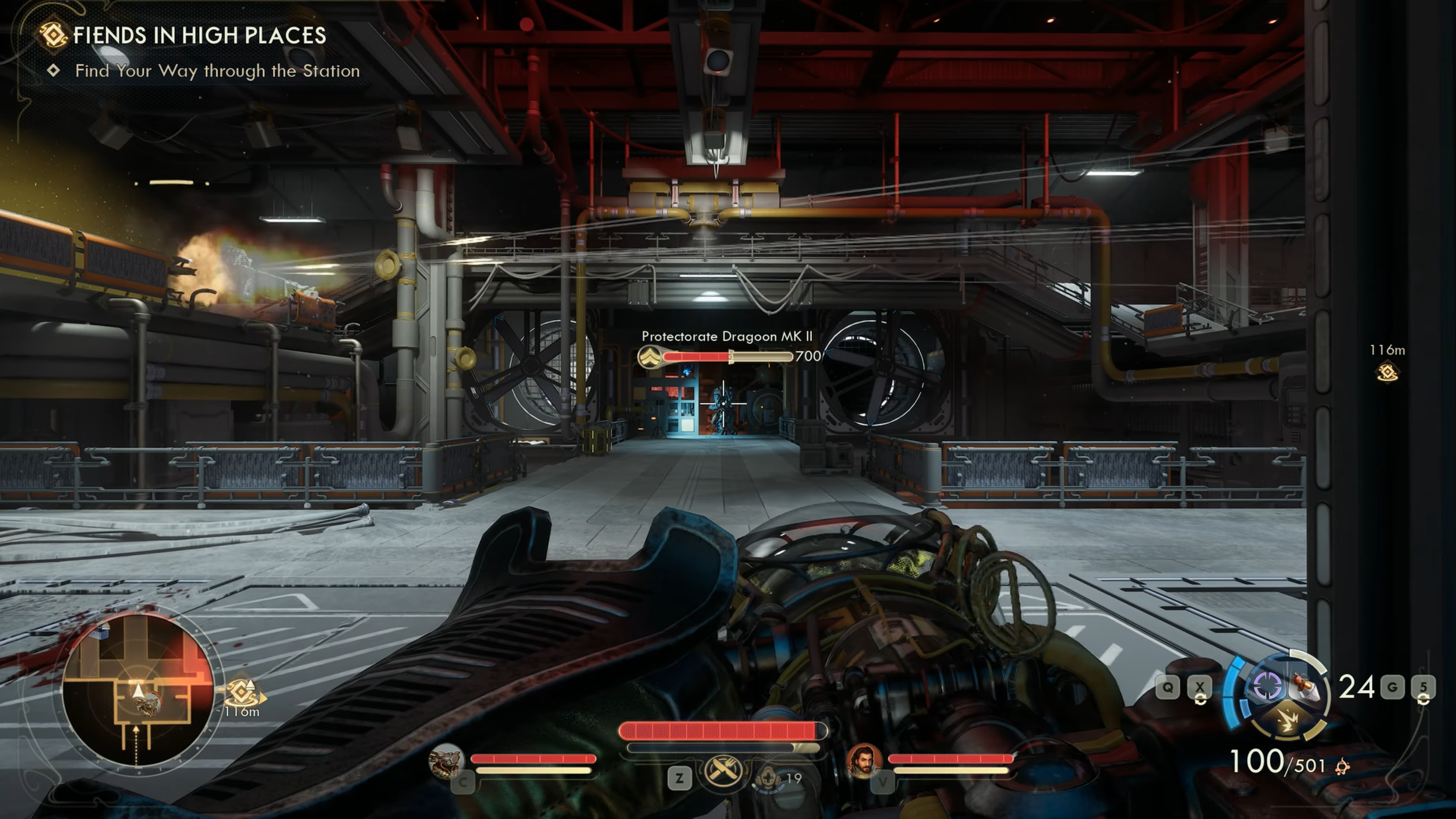
Automechanical Dragoon MK2 attacks a traitor in the Turbine Chamber
In the Turbine Chamber, players are able to preview the state of an encounter through the window next to the lift. In the event the player chose to forego saving the hostages at the Monastery (Previous Large Dungeon), the traitors would not have had time to secure the security codes needed to turn the station’s security mechs to their side. Failing to obtain these codes would result in hostile automechanicals patrolling throughout the station, providing increased resistance for the player and traitors alike. This resistance would be apparent through the window when the player arrives, as I scripted an encounter vs encounter attack to commence only when the player is able to see or hear it from the other side of the door. This allows for additional flexibility in how the area is approached. With the traitors and automechanicals distracted, the crouch tunnel door signaling a stealth route seems much more viable to sneak under and around the fire-fight undetected. Those more combat inclined may see it as a great opportunity to join the fray and pick off the weakest as they fight amongst themselves.
To account for the codes not being obtained, I needed to design the space in a way that created space for the player to enter the fray should combat already be underway, without taking direct fire from all angles. This was challenging due to the design constraints surrounding how Dragoons moved and the metrics required for their traversal and jumps. After iteration I was able to establish catwalks that gave ample space for multiple combatants including our Dragoons, while also ensuring their height and spacing between one another properly built our automatically generated jump down, jump up, jump across, drop-down, and vault navlinks. This parkour conscious and vertical crescent shaped mini-arena made for a far more dynamic space, as units had multiple routes for repositioning, cover, and gap-closing.
Automechanical Dragoon MK2s attack the player after opening the door to the Turbine Chamber.
In the event the player saves the hostages from the Monastery, Seer Wiley would have had time to send the traitors the station security code before being slain. When the player arrives at the Turbine Chamber the automechanicals can be seen patrolling alongside De Vries’s team. Players who have invested in the Hack skill can use a control panel by the window to shut down the mechs completely, or take control and force them to attack the traitors.
Consideration: Audio & Video Broadcasting
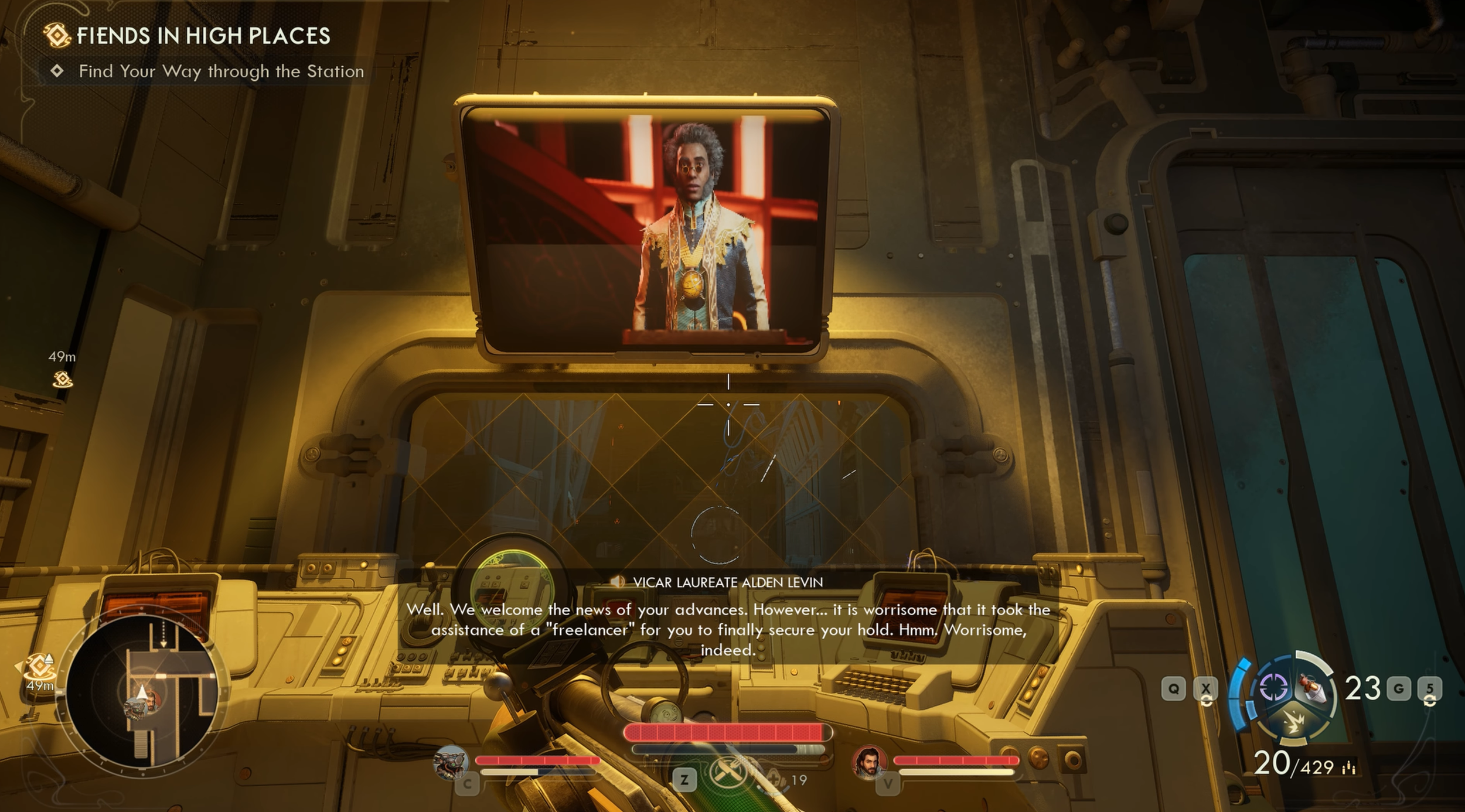
Order of the Ascendant Diplomat Alden Levin is seen and heard on a monitor in the Turbine Station engaging in peace negotiations.
One of my largest undertakings throughout development of The Outer Worlds 2 was working with tech art and programming to create video monitors and working alongside the Audio Department to create a Broadcast System capable of being a spatialized triggerable audio system implemented by Level Designers for their use-cases. This work first began when I was assigned to Greater Tranquility Station with the direction of having the player hear and see the delegates negotiating peace throughout the experience.
At the time of this assignment, we didn’t have a refined solution for having conversations play as videos, have their voice routed through multiple output speakers over large distances, play movie files over monitors with synced audio, or even play conversation audio out of speakers without the speaker being physically in the world. All of these scenarios were problems we had not solved for because until now we never had a “must-have” use-case for, especially along a critical path experience.
I took it upon myself to start from the ground up and create a new Monitor Abstract and children that were configured for designer placement. These monitors had the basic functionality necessary to get us through our early milestones, but required bandwidth from other departments to reach final quality. At this point I worked with all relevant stakeholders and departments to communicate feature requests and optimizations that would be dependencies for shippable quality.
It was at this point I was assigned to work with the audio team on developing the Broadcast System which would support monitor functionality, in addition to providing an easy means of allowing other level designers to set up physical speakers in their areas and port audio through them using our conversation system, while allowing the audio team to quickly do a pass later to refine fx and balance.
While I developed an early version for this location out of necessity, I never truly stopped owning, expanding capabilities, optimizing, and implementing monitors throughout the entirety of the Outer Worlds 2. With all the humility I can muster, if you saw a monitor in the game, I probably implemented it.